Friday, November 4, 2011

Nothing like a little sparkler-flame action on a cake!


Last week, my host sister Lara turned 7 years old. Two events of the week are worth noting. First, the trip to the bakery to purchase a cake; and second, the birthday party at the house.

On Tuesday evening, we left our house, and as we made a left turn onto the main street, Rami began to shout Rawan Cake…Rawan Cake! My host parents told him that we were going to Cado Cake. Well, that did not sit well with Rami as he then shouted Cado Cake muqaziz (disgusting) and began to cry. He cried the entire way to Cado Cake.

We arrived to Cado Cake and upon seeing the delicious looking desserts, Rami’s tears turned into a large smile. Lara and Rami began looking at the various books of different types of cakes. Rania, my host mother, was looking with them and helping Lara pick out a cake for her birthday, while my host father paced around the building, occasionally looking at the books.

I stood there reminiscing about my childhood when my parents would take my sister and I to the bakery to pick out our birthday cakes. We would look at every single picture of every possible cake for what seemed like hours. My sister and I were so intrigued by the tremendous amount of cake options that it became very difficult to make a decision. Lara struggled to make up her mind and I could tell that David was getting impatient and wanted to get going. I’m sure my parents acted in a similar way – hoping that the cake of dreams would be chosen and we could move on with our lives. What big decision we had to make as children!

I looked with Lara and Rami at some of the pictures of cakes, and found some of them to be very similar, nearly identical, to ones that I recall from my childhood. However, a few stood out, like the cake with images of Marlboro cigarettes or the AK-47 machine gun. I had a few laughs looking at those pictures!

On Thursday evening, we had a birthday celebration at our house for Lara. Several of her friends and their mothers attended the event, in addition to Peter, my host father’s brother, and Tata (grandmother), my host father’s mother. The evening was absolutely fantastic and it was such a joy to watch Lara and Rami and their friends playing various games, like a version of hot potato and musical chairs. The food that evening was delicious – pizza from the local bakery, homemade Tabouli (best I have ever had!), and various desserts, including the pink Princess cake!


At one point everyone gathered around the table in order to sing Happy Birthday to Lara. Rania picked up a lighter and then lit the candles. Recalling the various birthday celebrations that I have had as well as the ones that I have witnessed, I thought we would light the typical candles. However, these candles were more like a sparklers and flares combination. We lite all the candles and I thought for a second that our house would catch on fire! We sang Happy Birthday in English and then in Arabic.

Just wait, it gets even better. After singing to Lara, the candles (or in this case the sparkler-flares) were extinguished and removed from the cake. Then Rania placed another candle with the number 4 on it on top of the candle. At this point I was really confused. Everyone then immediately began singing Happy Birthday again! Yet, this time it was for Rami (however, his birthday was in August!). I have realized that if Lara gets something or does something, then Rami must as well. It made me laugh that all of Lara’s friends and their mothers began singing to Rami without any forewarning by Rania or David.

All in all the evening was quite wonderful. I think Lara had a wonderful time and it was definitely fun to partake in a birthday party for kids – something I have not been a part of in a long time.

Throughout this evening, I felt for the first time that this was in a sense my home and my family. I have begun to feel like an older brother to Rami and Lara, and a son to David and Rania. Today, I left for travels to Beirut and Cairo for the Eid Al-Adha break. As I said good-bye to everyone and gave hugs and witnessed the expected tears from Rami, I realized how much I will miss them this week and I think they will miss me as well. (In a future blog post, I will hopefully talk more about this).

Thursday, November 3, 2011

Photos from the Dead Sea and the Amman Marathon

Last weekend I ran the 10km Fun Run of the Amman International Marathon. I finished under an hour, which is not too bad for someone who doesn't run often and hasn't run since he arrived in Jordan two months ago.

I also went on a day trip to the Dead Sea. Check out the photos of me floating in the sea and with the mud all over my body!

Wednesday, October 26, 2011

The Call to Serve: Fr. Dean Brackley, SJ


Below is an article I wrote recently for Internaitonal Samaritan, the non-profit organization that concentrates its work on garbage dump communities throughout the world. In high school, I was able to attend several trips to San Pedro Sula, Honduras to work in the community of El Ocotillo. The past three summers I have interned with International Samaritan, and led service-learning trips to Honduras and Haiti. 

Click here to read my article on International Samaritan's website.


On November 16, 1989, six Jesuit priests and the housekeeper and her daughter were dragged from their rooms at the Jesuit residence at the University of Central America (UCA) in San Salvador, El Salvador. They were pulled from their rooms to the ground of the courtyard, where they were brutally murdered by members of El Salvador’s army. Shortly after their death, the husband and father of the housekeeper and daughter planted roses that still blossom and show their beauty to all those who walk by in reverence of those who made the ultimate sacrifice.

These roses serve many purposes. First most, they serve in memory of the eight individuals who lost their lives on that early morning in November. Secondly, the roses demonstrate what God talks about in the Gospel of John, that “the light shines in the darkness, and the darkness did not overcome it” (John 1:5). These roses remind us that despite the negative aspects of our lives - war, poverty, hatred, and neglect, to name a few - God’s light overshadows the darkness of our world. Despite all that is terrible and negative, God provides us with beauty - beauty that has the power to affect lives in midst of the terror and deep sadness that affected the poor and oppressed of El Salvador, as well as throughout our world.


Following the death of his fellow companions, Fr. Dean Brackley, SJ felt the deep desire within him to follow God’s call to El Salvador - to serve those who had lost some of their most outspoken advocates and friends, and to bring justice and love to a place in deep need for both. Fr. Brackley recalled years later, “I remember it affected me more than I would have ever thought.”

I could speak at length about the impact of Fr. Dean Brackley, SJ on the lives he touched in El Salvador, as well as the lives he impacted throughout the world. He was a theologian, a writer, an advocate for the poor and oppressed of El Salvador, and last but not least, a Jesuit (which I will return to shortly). He worked with the poor of El Salvador in the toughest of times, following the despicable murder of his Jesuit Brothers and the oppression and civil war experienced throughout El Salvador; he committed himself to bringing social justice to all in El Salvador and recognized the need for solidarity.

I had the privilege a couple of summers ago to meet Fr. Brackley with my fellow class mates, and teachers while on a tour of the Romero Center at the UCA. It was my second trip with International Samaritan to El Ocotillo, Honduras, volunteering with International Samaritan at the garbage dump community on the outskirts of San Pedro Sula. At the end of our 10-day service-learning trip, International Samaritan organized a retreat to San Salvador, El Salvador to witness the work of the Jesuits in serving the poor and oppressed.

Upon our arrival to the Romero Center, Fr. Brackley was waiting to greet us since the University was closed due to a holiday. Seeing our reservation for the day and noticing our Jesuit connection with International Samaritan and our high school, University of Detroit Jesuit High School, he decided to take the time out of his day to show to us part of recent history, the struggle for social justice and also to invite us into part of his own life.

I recall watching a documentary that highlighted Fr. Brackley’s decision to work in El Salvador and remember reading various articles about him and written by him. How impressed I was by his love for the poor and his commitment to serving “those without a voice.” After spending a couple of hours with him, I could feel the passion of his desire to serve God and all of mankind - it was contagious!

Now, back to his Jesuit identity. Shortly after his death, a friend asked me about Fr. Dean Brackley. “Who was this priest? What did he do?” I told my friend, “If I had to give you one word to describe this man - and all his deepest desires, his thoughts, words, and deeds, his passion to serve the poor and oppressed - all I would have to say is that he was, and always will be, a Jesuit.

At the UCA reads a plaque in the chapel (I have translated it into English from Spanish):
What does it mean to be a Jesuit today? It is to engage, under the standard of the cross, in the crucial struggle of our time: the struggle for faith and that struggle which it includes.

Fr. Brackley, SJ embodied all the characteristics and attributes of a Jesuit. He worked towards the “service of faith and the promotion of justice” (35th General Congregation of the Society of Jesus). His actions and words serve as prime examples of his ability to set the world on fire - starting fires within the hearts and minds of those he taught at the UCA, those he served in the poor communities in El Salvador, and those throughout the world that have been affected by his commitment to social justice and solidarity - which has encouraged others to start fires elsewhere.


Fr. Brackley, I thank you for your presence in the lives of the poor and oppressed, for the decision you made years ago to serve “those who have no voice” in a country filled with injustice and violence, for your commitment to building the Kingdom of God here in on earth, and for the impact and influence you have left on me - in my heart, in my thoughts, and in my actions. Thank you for the difference you have made on this world - for the roses that blossom as a result of your ministries.


Saturday, October 22, 2011

The Beauty of Mass (…in English)


For the past month I have been attended an English speaking Mass at St. Mary of Nazareth, a Catholic parish in Swefeih. I discovered this Mass when I went to the parish one Saturday evening with my host family for the wedding ceremony of one of their friends a month ago. It is a beautiful parish in a somewhat affluent neighborhood. I am reminded of Altar Road in Dearborn, Michigan when I look across the street to see a mosque – amazing to see two different religions being practiced right across from one another.

Unbeknownst to me was that the Jesuits in Amman presided at this Mass on Saturday evenings, along with the other English speaking Masses at various parishes throughout Amman. However, I was aware prior to coming to Jordan of the Jesuit Center in Amman where several Jesuits have been missioned. (Hopefully in another post in the near future I will talk about the Jesuit influence in Amman and the Middle East!)

The parish of St. Mary Nazareth, in which I have been attending for the past couple weeks now, is filled with parishioners on Saturday evening, the majority of which are Filipino. Amman houses a large number of Filipinos, particularly women, who works as maids in various households throughout the city as well as other jobs. This Mass also includes families with younger children as well as some elderly people. Thus it is somewhat of a mixed bag.

Nevertheless, it has been great to have Mass in English and understand everything that is taking place (compared to my experiences at Arabic-speaking Masses, which combine the formal Modern Standard Arabic and the local Jordanian dialect, making it extremely difficult for me to understand).


After Mass one Saturday, I wrote this in my small journal:

As I sit in the church preparing myself for Mass, I am immediately drawn to the music coming from several Filipino women who sing and play the guitar during the English speaking Mass on Saturdays in Swefeih and on Sunday evenings in Jabal Hussein.

My eyes begin to tear up as I sit marveling at the beauty of their music. Despite being accustomed to more traditional music back home like the 9:30 pm Mass in Dahlgren Chapel or even the 7:30 pm contemporary Mass, the majority of the music for this Mass is typical to these women. And after hearing about some of their own stories the other night by Fr. Paul, I cannot but feel sadness and remorse. I feel sick to my stomach to think that there are people who must work and live the way they do. And for them this Mass might be the best part of their week. The time is not only seen as a time to be with God and to bring themselves, as the imperfect human beings they are (and we are), open and vulnerable to the beautiful mystery of Mass and to share in the Eucharist. But it also serves as a time of fellowship with their friends and this community – a time to enjoy some normalcy (if there is such a thing).

Despite being accustomed to the music at parishes back in the States, I find it quite beautiful and amazing that these women are able to bring their talents and their passion and love for serving Christ in this way, and share it with everyone who attends Saturday Mass.

In the Gospel of John, Jesus speaks of the darkness that inhabits the earth. Yet despite the darkness, he gives us encouragement with the presence of the light. The light at times may seem to be overshadowed by the darkness but as far as I am concerned the light, no matter how big or how much, will always overcome the darkness.

As I pray in the Church, I ask God for the grace of happiness. To recognize that many are happy in this world and have nothing. I am comforted time and time again as I spend time with the poor, the oppressed, the sick and the weak – they show me what it truly means to be a child of God and what happiness truly is. It is my greatest hope that I am able to find true happiness and love like they have.

Sunday, October 16, 2011

Visiting Biblical Sites in Jordan


Yesterday, I ventured to several biblical related locations in Jordan with an organized trip from CIEE, my study abroad program. Check out Photos from the trip and these photos too!

Our first stop was Mukawir, the hilltop fortress of Herod the Great. Following Herod the Great’s death, his son Heard Antipas inherited the stronghold. It is on this mountain where John the Baptist is said to have been imprisoned and later beheaded by the orders of Herod Antipas.

There was not much to see on top of the mountain, since the stronghold itself was mostly destroyed from an earthquake. Yet a few pillars are still upright. Despite the lack of much to see on the mountain itself, the view of the Dead Sea was beautiful. After the hike up the mountain and the sun beating down, all I wanted to do was take a swim in the Dead Sea (unfortunately we did not have time and it was not as close as the view made it seem like it was).

Our second stop was the city of Madaba. Years ago, Madaba was inhabited with Christians primarily. And still today, Madaba is still significantly Christian with Muslims living there as well, and the sight of mosques and churches throughout the city demonstrates the ability for two people of different faith traditions to engage in dialogue and friendship.

In Madaba, we visited St. George’s Church, a Greek Orthodox Church, that houses the mosaic map of the Holy Land. The map is believed to date back to 560 AD, covering the front section of the Byzantine church that was erected prior to the Greek Orthodox Church in its place. The mosaic map of the Holy Land provides a clear view of the walled city of Jerusalem with the Church of the Holy Sepluchre, the Dead Sea, the Jordan River, Jericho, the Nile Delta in Egypt, and southern Lebanon.

I am still amazed at how this mosaic map has been persevered still to this day. After witnessing several Jordanians creating mosaic masterpieces in a shop nearby, I believe that this around 6 years to complete. The intricacy, precision, and patience involved in the process of creating a mosaic masterpiece like this is unbelievable. Unfortunately, if I were given the task of a mosaic-maker, I would probably be out of job in a day or two.

Our third stop was Mount Nebo where there is a gorgeous view of the Holy Land and the River Jordan. It is here that God gave Moses a view of the Promised Land. After years of abandonment and neglect, the Franciscans purchased this site in 1993 and excavated and restored the area. Pope John Paul II visited Mt. Nebo during his pilgrimage to the Holy Land on March 19, 2000. He planted an olive tree next to the Byzantine chapel for peace. As a Catholic, it was a very special experience, having the opportunity to visit an important biblical site.

Our final stop was to the Baptismal Site of Jesus at Bethany-beyond-the-Jordan. A recent discovery, excavations on the Jordanian side began in 1996. This biblical site is where it is believed that John the Baptist lived and baptized Jesus. It was a long walk from the entrance at the Visitor Center to the site of Jesus’ baptism. Walking down a long, dirt path with trees and shrubbery along the path, I had a very solemn and graceful journey to the site on the River Jordan. 

This experience brought to mind my passion for serving others and my desire to do all that do for the Greater Glory of God (AMDG). I imagined what it must have been like years and years ago when John baptized Jesus, and at the age of thirty Jesus began his ministry in spreading the Gospel, curing the sick, and serving the poor. I was able to place my hands in the River Jordan where he was baptized. Despite the lack of cleanliness of the water, I still felt rejuvenated in a sense – knowing that I am being called to serve God in a unique way.

Despite the general tourist nature of our trip, for me it was much more than that. I felt the presence of God in a different way, in a reassuring and comforting way. I wish I could have spent more time at these sites, yet I am thankful that I was able to make this journey. 


Friday, October 14, 2011

Do childhood fascinations lead to one’s deepest desires in life?


After spending a couple hours in Madaba last Friday visiting several Orthodox parishes, we went to a special Mass at St. Charbel Catholic Parish for the members of Focolare (which my host family participates in), a religious movement whose focus is to promote unity between people from similar and different backgrounds, with its primary members being Roman Catholic, although members include other Christian denominations, and other religions. Arriving early to Mass, Rami and Lara, my host siblings, played with some of their friends for a while, running throughout the parking lot. Well, in the parking lot there is a tree, and every time that Rami ran by the tree, he would slow down and gaze at this tree. This did not just happen once, or twice. But every time that he ran by it, he would casually look in wonder at the tree.

For Rami, this is not his first time that a tree grabbed his attention. In my host family’s home, we have a large plant next to the couches in the TV room. Rami loves to lean over the end of the couch and play with this plant, even sometimes taking off its leaves. Another example is that every time we leave our fourth floor apartment, we push the button for the elevator. And while we wait for the elevator to make its way up, Rami loves to walk over to the fake tree standing in the corner by the elevator, and he reaches his hands out, grabbing the base of the tree, and attempting to bring it with him. This honestly happens every day.

I think I can say that Rami is obsessed with trees. There is something about trees, or plants in general, that has captured Rami. Every time he comes across them, he cannot but help to stop.

So where am I going with this? Well, for the past month that I have been living with this family, I have continually witnessed the fascinations of a child, and it has made me think about some of my own obsessions as a child, and I have thought about how those interests and desires have impacted my life up to this point.

What is the relationship between our obsessions, our desires, etc. as a child to those that we have as an adult? Do our childhood interests and fascinations ultimately lead to our desires and passions later in life?

As a child, my parents would tell you that I was obsessed with farms, playing with Legos and Playmobil (both which my mother refuses to give away), and probably the most significant fascination was law enforcement. For a very long time up through high school, I had dreams of working in law enforcement as my life’s career. Year after year, grade after grade, my desires to pursue that line of work continued to grow and progress from local law enforcement to state level to national level, and ultimately international.

I know now that as I continue to grow older and work towards the completion of my undergraduate studies (which is a lot closer than I think!), I will not be pursuing a career in law enforcement. But I would be lying if I said that those childhood dreams and desires, and even obsessions, did not have an influential role in making me the person that I am today, as well as influencing the person that I want to become.

In one of my college essays I alluded to my construction and passion of Legos. I loved the work needed to make a mega-city, or the teamwork involved in creating various Legos constructions with my classmates in the after-school program in elementary school. I used this as a metaphor to demonstrate that when I am passionate about something I invest my entire being into it, and the teamwork aspect reinforces in me the need to work with others and that relationships above many other things are more important and can have such a strong impact on the person that you are and the person you become.

I have always been an Action movies/TV series fan. From Chuck Norris to Keifer Sutherland to Will Smith movies, I have enjoyed ever one that has involved law enforcement and saving lives, whether it was throughout the state of Texas in Walker, Texas Ranger, or Keifer Sutherland as Jack Bauer in 24 saving the world (literally!), and Will Smith in Bad Boys as a member of Miami’s elite squad, the Tactical Narcotics Team. I would also be lying to you if I did not fantasize about being them in their roles in these TV series and movies. Sure their martial arts skills were impressive, and their commitment to justice inspiring, but I think my overall attraction to these movies and to a life in law enforcement was the ability to help others, whether that be one person or an entire country.

Now, looking back, which is good to do from time to time, I reflect on where I am coming and where I am going. I have been doing a daily mediation for the past 4 weeks now, from Mark Link, SJ’s “Challenge” and this past week I was reflecting and praying about the meaning of my life. It has been such a graceful and refreshing week, reminiscing over my past 20 years and looking forward to the years ahead of me. I find it amazing how different experiences, events, and people in my life have impacted me in such different ways and to various degrees. So who knows, maybe Rami’s love for trees will resurface again and again throughout his life, or maybe it is just his 4-year-old obsession.

I use my previous obsessions and desires as a way to see where I am grounded most. My love for Legos showed me how passion and love can affect an individual and as Fr. Arrupe, SJ said, “[love] can decide everything.” My desires to partake in law enforcement led me to hear and understand my call to help others and to serve those in the greatest need.


Saturday, October 8, 2011

Riding Camels and Drinking Tea with the Bedouins: Travels to Dana, Wadi Rum and Petra


Last weekend, I ventured to southern Jordan. The Dana Nature Reserve and the Wadi Dana, the Shobak Crusader Castle, Wadi Rum, and Petra were the attractions for the weekend. Check out my Photos from Dana, Wadi Rum, and Petra.
   
We began out trip to the Dana Nature Reserve, overlooking Wadi Dana and located about 202 km south of Amman. From the moment I walked off the bus, smelling the fresh air, feeling the combination of hot weather and a nice breeze, and witnessing an absolutely beautiful view of the 320 sq. km of the Dana Nature Reserve, I knew that this trip would be nothing like I had experienced so far in Jordan.

Overlooking Wadi Dana was absolutely stunning. However after hearing we had to walk all the way to our campsite from the top of the mountain, I was not too thrilled. The walk was downhill so it didn’t require much effort, although you had to be carefully in your steps because of the loose gravel. The views from our hike downhill were beautiful as well, seeing Wadi Dana from different perspectives. We arrived to the Rummana campsite, where a portion of us camped for the night. Before sunset, we took an hour and a half long hike with a Bedouin man on the Campsite Trail, providing us with gorgeous views of the northern part of Wadi Dana.
 
On Saturday morning, I woke up around 6:15 am with my friend Matt so we could watch the sunrise. We climbed some rocks to get a better view and sat on top of those rocks watching the sunrise. It was such a peaceful and beautiful experience – wish I could do that more often.

We left Wadi Dana in the morning for Shobak castle. We spent less than an hour at the castle, as there was not too much to see partially due to its rather ruinous state. However, it was still worth the visit as the Shobak castle was the first castle built by the Crusaders in Transjordan.

Our travels continued with Wadi Rum – the highlight of my trip. Wadi Rum is known for its vast deserts and sandstone mountains explored with camels and 4x4 jeeps. We arrived at the Visitor Centre at the entrance of Wadi Rum where we enjoyed lunch at Captain’s Restaurant before hopping on the 4x4 jeeps. For around 2 hours we explored the desert of Wadi Rum via the back of a 4x4 jeep. It was a blast driving on the back of a jeep and we were able to stop at a couple places throughout the drive. Two places stood out to me: one, the “Seven Pillars of Wisdom” rocks referring to Lawrence of Arabia’s famous work and his presence in Wadi Rum years ago; and second, a large Bedouin tent located next to an inscription of Lawrence of Arabia in a large rock. The experience in the Bedouin tent was enjoyable for two reasons: first, I received tea which I am a big fan of; and second, this experience showed some inherent characteristics of the Bedouins, particularly their hospitality.

A side note with the 4x4 jeeps. All the jeeps were owned and driven by locals who live in the Wadi Rum area. After getting in and out of the back of our jeep a couple times, we realized that our driver looked rather young. Not like someone my age, 20, or in their 30s. Rather our driver had to have been around 13 to 15 years old. And this is no joke. We also parked our jeep at one point, and our driver left the truck and opened the engine cover – apparently our engine had overheated (all the other people around us were laughing, but we weren’t). Luckily he was able to fix it within a matter of seconds and off we went.

After the jeeps, we were on to our second mode of transportation – camels. Abdul Rahman, a 15 year old Bedouin, was our guide for the next two hours. Four of us rode with Abdul Rahman – at least for a little bit. One of our friends was having a difficult time with the saddle as it kept sliding towards the camel’s rear end. After a short while, it was obvious that this couldn’t last for 2 hours or else we would be arriving to the campsite when it was pitch black outside. I felt bad for our friend but luckily she did not fall off or anything like that. As we were finishing our camel ride, I did witness one of the students on the program fall off his camel. He was wearing a traditional cloak (not sure why?) and let’s just say that when he fell, his cloak moved up his body and all that was visible was his compression shorts (again not sure why he was wearing that – definitely better than nothing!).

The ride overall was enjoyable, although a little rough on my thighs. Our camels, all of which were pregnant, were attached via a rope to the lead camel that Abdul Rahman was riding. My camel, Rema, kept trying to get ahead of two of the camels by riding up faster in between the two of them. Well, every time this happened my feet, which were hanging to the sides of the camel, kept riding up into the rear end of the other camels – hopefully the camels weren’t upset about that!

Between the jeep and camel rides, I had the best view of the desert and I felt like I was really experiencing it as well. We arrived to another Bedouin campsite where all the students stayed for the evening. The tents in this camp were better than the previous night and I had another graceful rest. The evening was filled with amazing food, sitting in a large circle, watching traditional Bedouin dances and even a mock Bedouin wedding ceremony.

On Sunday we left relatively early for Petra – one of the seven wonders of the world. To be honest, I did not know much about Petra until this summer when family and friends would ask me about my upcoming study abroad plans. When I mentioned Jordan, they always referred to visiting Petra where Indiana Jones took place. So I had no real idea what I would be experiencing. And it did not help that our weekend guide, “Jerome” (at least that’s the name I gave him), told us prior to entering Petra that there were two types of people in Petra: the Bedouin and the Bdul (who lived in the caves of Petra for many years until being forced to move) tribes. He told us not to talk to the Bdul, as they are “very different people – different shape, different form, different size, and different color.” What is that supposed to mean? Thus entering Petra I expected to see an alien or something completely foreign that I would struggle to stop staring. However, I could not tell who was a Bedouin and who was Bdul, and I am actually content that I could not tell the difference, as it may have shaped my image of different tribes – and I found everyone in Petra to be welcoming, hospitable, and enjoyable to interact with.

Petra was home to the Nabateans over 2,000 years ago and was abandoned when the Romans arrived in 106 AD. From roughly 1300 to 1800, the Bedouins kept Petra a secret until in 1812, when a Swiss explorer rediscovered it. Now, Petra serves as Jordan’s most valuable treasure and its greatest tourist attraction.

As we walked through the siq (the main entrance to the city), it was impressive, especially to see the remaining inscription on some of the rocks, as well as the water channel and location of where a damn previously existed. Yet nothing beats walking through a valley covered by two lines of jagged peaks and from what seems like out of nowhere appears a magnificent gem – the Treasury.

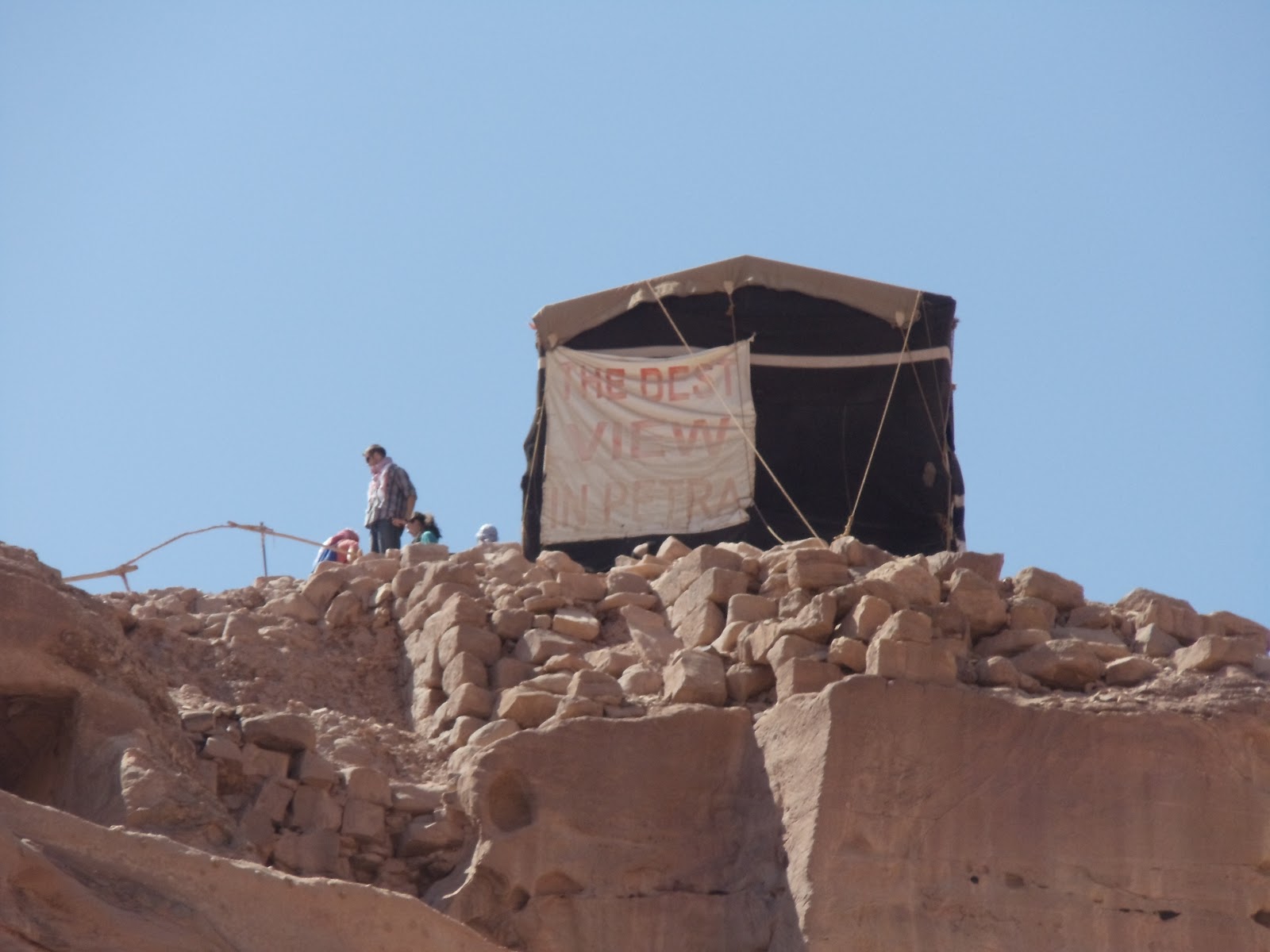
After lunch we had a couple hours to explore. A group of us set out to reach the “Best view of Petra” – however there happen to be several. Walking to the Monastery was an experience. It took roughly 45 minutes, walking up the Nabatean-carved sandstone steps, passing local Bedouin families encouraging us to purchase one of their items, using the little English they know: “Buy one for your wife, she loves you more” or hearing the kids with donkeys available for transportation to the Monastery saying “Air-condition taxi, mister?”.

In addition to our journey up to the Monastery, I stopped at one of the local Bedouin’s tents, where a friend was sitting with an older woman drinking tea. He introduced the woman as his “grandmother” – she was not his grandmother yet he knew her well from his days as a Petra guide. She offered us tea and, yet again, I enjoyed the genuine hospitality of a local Bedouin. After a few minutes of resting, I continued the hike to the Monastery. The best view of the Monastery was further past its ground level. From one of the many “best views of Petra” offered by the local Bedouins, there was a perfect view of the Monastery, carved into the rock similar to that of the Treasury. There were also breathtaking views over the peaks down to the Petra basin and Wadi Arabia in the distant.

The journey back into Petra was quite relaxing as it does not require anywhere close to the effort needed going up. As I walked down, I noticed several donkeys coming up and coming down. However, people were only riding the donkeys up to the Monastery and not back down to Petra. Not only is the hike down a lot easier, but riding a donkey down seems to just call for a death sentence. I would not trust anything, especially a donkey, with my life going down on uneven and rocky steps and curves.

Overall, this weekend trip was relaxing with breathtaking views of historical places and gorgeous environments. It was definitely a nice break from the urban city of Amman where the sounds of cars and traffic permeate everywhere you are in the city. From this trip, I concluded three things: one, I dislike large groups to the extent that it is more difficult to do what you want to do since there are over 100 other people to consider, and it reinforces the tourist persona, which I usually prefer not to have; second, the nights sleeping in the tents reminded me of my love for camping and sleeping outdoors in very basic accommodations – makes me miss Grandpa’s Land; and third, the genuine hospitality of the Bedouins whether it be of their offerings of tea (which I love!) or while on the camels or even just in passing, is something that should be noted by every visitor of Jordan and even every native of Jordan – it encourages me to show genuine care and hospitality towards others whom I have never met.